Every July, Disability Pride Month celebrates the identity, achievements, culture, and contributions of people with disabilities while also recognizing the ongoing need for accessibility and inclusion across society. The observance intersects the anniversary of the Americans with Disabilities Act (ADA), signed on July 26, 1990, which marked a historic step toward protecting the rights of people with disabilities.
In 2026, Disability Pride Month carries even greater significance as organizations worldwide are more focused to design digital experiences, workplaces, communication systems, and public services that serve everyone equally. Accessibility is no longer viewed as an optional enhancement, it has become a fundamental expectation for businesses, educational institutions, government agencies, and enterprises.
The 2026 theme, “The World Works Better With Us” - highlights the importance of inclusive participation and reminds organizations that accessibility improves experiences not only for people with disabilities but for all users.
Understanding the meaning of disability pride month
Disability Pride Month promotes self-acceptance, equal participation, and the removal of social, physical, and digital barriers.
The movement encourages society to move beyond sympathy-based perspectives and toward genuine inclusion. It also amplifies conversations around representation, independent living, accessibility rights, and equitable opportunities in education, employment, healthcare, and technology.
Disability Pride Month is observed through:
- Accessibility awareness campaigns
- Community events and advocacy programs
- Inclusive workplace initiatives
- Educational webinars and workshops
- Digital accessibility improvements
- Social media campaigns
The history behind disability pride month
Disability Pride Month was first observed shortly after the ADA was enacted, with communities organizing events to understand disabilities and civil rights progress.
October 6, 1990, was the day when the first Disability Pride parade happened in Boston and over 400 people marched, wheeled, or participated in the parade. It was a successful initiative; however, other cities took a while to host such gatherings. In 2004, Chicago hosted the longest-running series of Disability Pride Parades. And then, all the major U.S. cities began organizing these parades since 2012 including New York, Philadelphia, Los Angeles, and Buffalo.
Over the years, the movements evolved from awareness-focused events into a broader cultural celebration emphasizing inclusion, representation, and innovation in accessibility.
Disability Pride Month also intersects with the growing global focus on:
- Digital accessibility compliance
- Inclusive design practices
- Neurodiversity inclusion
- Accessible education systems
- Barrier-free workplaces
- Assistive technology adoption
The Disability Pride flag and its meaning
The Disability Pride flag symbolizes solidarity and inclusion across the disability community. Originally designed by Ann Magill, the flag was later refined to improve accessibility for people with photosensitive conditions.
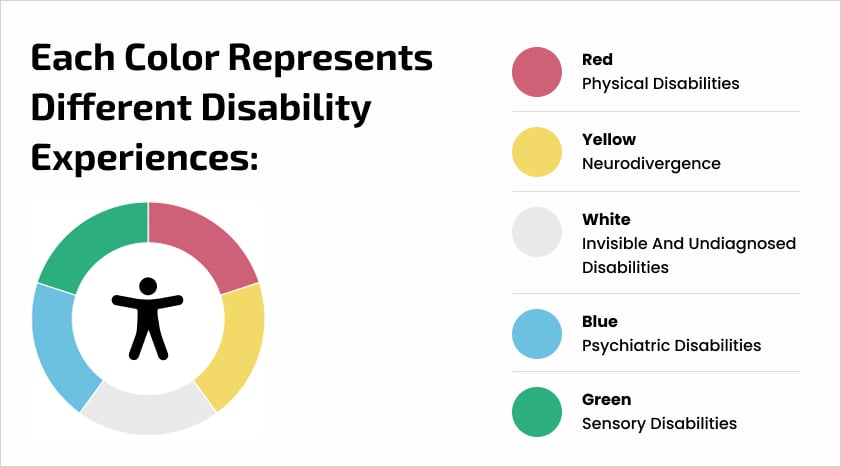
The diagonal design represents breaking barriers and creating pathways toward accessibility and participation.
Reason why digital accessibility matters during disability pride month
As businesses continue to expand their digital presence, inaccessible websites, applications, PDFs, and other web tools can unintentionally exclude millions of users.
Digital accessibility ensures that people with disabilities can independently browse websites, access educational content, shop online, apply for jobs, complete financial transactions, use healthcare portals, and engage with multimedia content.
For many individuals with disabilities, accessible digital experiences directly impact independence, confidence, productivity, and equal participation in society.
Organizations that don’t prioritize accessibility often create barriers such as:
- Poor keyboard navigation
- Missing image alt text
- Inaccessible PDFs
- Low color contrast
- Videos without captions
- Complex navigation structures
- Screen reader incompatibility
- Non-accessible forms and buttons
Inclusive digital design benefits everyone
Accessibility improvements benefit all users because accessibility practices often become mainstream usability enhancements.
Examples include:
- Closed captions help users to read video/audio content if they cannot hear it.
- Voice commands improve the task completion efficiency of users.
- Mobile-friendly and responsive layouts fine-tune readability.
- Clear navigation helps older adults and first-time users.
- Accessible color contrast improves visibility outdoors.
Thus, inclusive design principles should be integrated into every stage of digital development.
The growing importance of accessibility compliance in 2026
Organizations are now increasingly expected to align with standards such as WCAG and ADA requirements to ensure equal digital access.
Accessibility has become a strategic business priority because it impacts:
- Brand reputation
- User trust
- Customer retention
- Legal risk reduction
- Search engine performance
- Market reach
- Corporate social responsibility initiatives
Enterprises, educational institutions, ecommerce businesses, and public sector organizations are actively investing in accessibility audit, remediation strategies, and inclusive UX improvements.
Creating a more accessible online experience
Organizations can strengthen digital inclusion through some reliable steps:
Conduct accessibility audits
Regular accessibility testing helps identify barriers across websites, mobile apps, documents, and digital tools.
Improve content readability
Clear headings, plain language, structured layouts, and accessible typography improve comprehension for diverse users.
Prioritize keyboard accessibility
All essential functionalities should remain usable without requiring a mouse.
Add captions and transcripts
Accessible multimedia supports users with hearing impairments and improves content usability overall.
Optimize for screen readers
Semantic HTML structures and descriptive labels improve compatibility with assistive technologies.
Ensure accessible PDFs and documents
Many organizations overlook document accessibility, creating barriers in reports, forms, brochures, and educational materials.
Accessibility widgets can support inclusion
Accessibility solutions and assistive enhancements help organizations improve usability while supporting broader accessibility goals.
An accessibility widget like All in One Accessibility offers various assistive features to personalize users’ browsing experience according to their accessibility needs. It has in-built capabilities to improve digital usability for individuals with visual, cognitive, motor, and age-related accessibility challenges.
However, accessibility widgets work best when combined with long-term accessibility strategies including accessible development practices, WCAG audit, remediation efforts, and inclusive design planning.
Disability pride month and the future of inclusive technology
Emerging technologies such as AI-powered accessibility tools, voice interfaces, automation, and adaptive user experiences are reshaping digital inclusion. However, technology alone cannot create accessibility unless inclusion is intentionally prioritized during design and development.
The future of accessibility will increasingly focus on:
- Personalized user experiences
- Inclusive AI systems
- Accessible ecommerce platforms
- Barrier-free digital education
- Cross-device accessibility consistency
- Accessible mobile-first experiences
- Inclusive workplace collaboration tools
Organizations that proactively embrace accessibility today will be better positioned to create equitable digital experiences tomorrow.
Wrapping up
Disability Pride Month 2026 is more than a commemoration – it is a reminder that inclusion should be embedded into every digital interaction, workplace initiative, and customer experience.
Inclusive websites and applications support organizations in building stronger connections, improving user experiences, and demonstrating a genuine commitment to diversity and inclusion.
At Skynet Technologies, we help businesses, educational institutions, government organizations, and enterprises strengthen digital accessibility through accessibility audits, WCAG remediation, and accessible design solutions. Create a more inclusive digital experience and move confidently toward long-term accessibility compliance and usability for all users.
Reach out to hello@skynettechnologies.com for more information.