While English serves as the dominant language in today's global digital world, it is essential to recognize that not everyone is proficient in or comfortable using it exclusively. In fact, over 50% of Google queries are in languages other than English. Considering this statistic, website owners should be aware of the significance of website localization to effectively improve their international users.
Accessible website can cater content to diverse locales, facilitating seamless access across multiple languages. Website localization allows linguistic communities and audiences to interact more effectively with content. It also applies to individuals with disabilities who use assistive technologies. The localization of a website involves updating both visible and underlying content, such as image alt text, adjusting for different time zones, or changing the format of dates, times, measurements, and addresses, to ensure accessibility and usability for everyone.
So, let us understand what website localization is and how it is helpful in fostering web accessibility.
Website localization and its importance!
The process of tailoring the website’s content to desired languages, cultural preferences, and currencies to reach out to international markets is called Website localization. The basic idea is to make sure that the digital content is accessible to every user despite their physical abilities and language knowledge. It helps build a stronger brand image and connections with the target audiences.
Website localization is crucial because it enhances its effectiveness by captivating users from various localities because users have access to the relevant content that meets their cultural expectations. On the contrary, a non-localized website has a negative impact on users with disabilities since it ultimately reduces accessibility.

Web accessibility facets that are crucial in the localization process!
Often some of the website accessibility aspects left overlooked while design/development process that are Language attributes, Image alternatives, Title attributes, ARIA-label attributes, Off-screen positioned CSS text, Table summary attributes, Page titles, and long descriptions.
Moreover, all web pages must be responsive for all devices because unresponsive pages may deliver information in a different way, which may change the whole perspective of content.
Zoom feature is required for low-vision users. WCAG expects that a minimum of 200% zoom should be available for users for better visibility. Also, pinch zoom is needed for mobile devices.
Dynamic content requires thorough testing to avoid errors.
Do not forget to localize a page that has a long description for images.
WCAG has four main principles to make content accessible that is perceivable, understandable, operable, and robust.
Multiple Language Accessible Website goes through some perceivability issues such as alternatives for non-text content, captions and audio description for time-based media, meaningful sequence, background audio, and sign language. These facets need special attention to complete website localization process successfully.
Another principle is the understandability of digital content and the key issues for localization are related to language identification, reading level, difficult or unusual words, pronunciation, and error management.
To mitigate these issues, content must be properly translated into local dialects without changing the core concept and meaning of the main content. Basic reading level with easy-to-understand words required in sentences.
Operable issues for website localization are bypassing blocks of content, page titles, link purpose, focus order, and headings. Keyboard users and people who access web pages via some assistive means must be able to tab on each link on the page concealed with keyboard focus. All headings, labels, and sections must be clearly represented on the web pages so that users can navigate through the structure seamlessly.
And finally, the content must be machine readable offering consistent experience to all the users, according to the last principle of WCAG (robustness of content).
Moreover, if update the website for the latest version of the technology, make sure you do a thorough testing of all components to check if they are still accessible or need to be fixed.
Process to begin Website Localization!

Website localization prerequisites
- Comprehensive research of the target market is required to collect important insights (such as language, cultural requirements, demographics, etc.) including disabled users’ statistics.
- Gather data on user behaviour to optimize content for enhanced user satisfaction.
Technical requirements
- Choose a CMS or technology to build a website that has multilingual, and accessibility features in-built. Therefore, content translation can be done without disturbing accessibility.
- Focus on SEO techniques to ensure that local users can find the website easily.
- Language selectors or language switchers can be implemented so that users can switch between different languages.
Localise the website
- Begin incorporating all the essential facets mentioned in the above section that are based on WCAG requirements to make an accessible localized website.
- Ensure the website contains content for specific locality along with generic content.
- There should be a robust translation management system to maintain centralized management of translation resources, glossaries, quality, and workflow.
Testing of the website
- A thorough check for linguistic and WCAG success criteria is needed to understand the level of user experience.
- Assistive technologies must be tested with localized websites.
The Benefits of Ensuring Accessibility in Localization
Website localization can surely improve accessibility and hence organization’s overall impact.
Improve Website SEO: Localizing and translating content in a way that considers accessibility factors can improve search engine optimization (SEO) performance.
Improve User Experience: Enhance the overall user experience by catering to diverse language and cultural needs, resulting in higher engagement and satisfaction.
Increase Revenue Opportunities: Helps to open up new markets and revenue streams by making products or services accessible to a wider audience.
Enhance Brand Reputation: Demonstrating a commitment to inclusivity and accessibility in website localization and multi-language can improve brand reputation.
Wider Audience Reach: Making digital content accessible to individuals with disabilities will allow you to reach a wider audience, including those who use assistive technologies to navigate digital content.
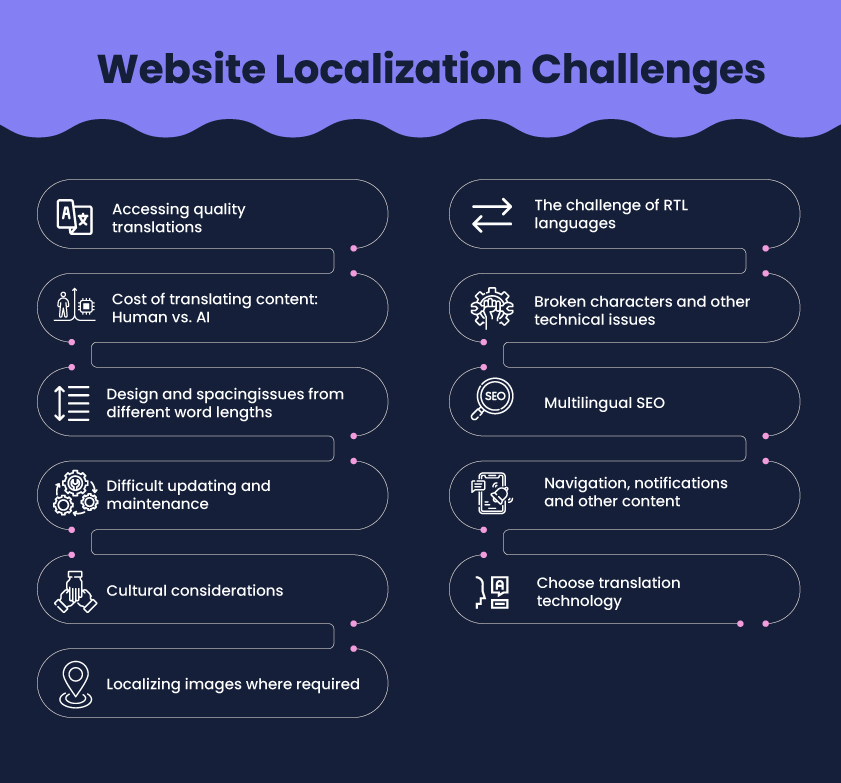
Skynet Technologies Helps Make Localized Content More Accessible
Website Localization for Web Accessibility goes beyond translating words into another language. It means adapting content, navigation, multimedia, forms, and user interfaces so people from different linguistic and accessibility backgrounds can understand and use a digital experience with greater independence. Combining localization with accessibility can help organizations expand their global reach while creating more inclusive experiences for diverse audiences.
Skynet Technologies supports organizations with website accessibility audits, remediation, accessible design and development, multilingual accessibility, document accessibility, accessibility consulting, monitoring, maintenance, and ongoing support. Our AI-powered All in One Accessibility solution also supports website visitors across 190+ languages, helping organizations address accessibility and language barriers together. Get a Free Accessibility Quote to discuss how your website can deliver a more inclusive experience for global audiences.