“Being hard of hearing is not a disability, it’s just a different way of being able to hear.”
Apparently, the numbers of people with hearing loss are increasing yearly and it is predicted that upcoming years will see a rapid surge in current numbers.
Whenever a problem increases, demand for an apt solution also grows. So, this enhancing problem is asking to build more accessible digital spaces because post-pandemic people are relying more on such spaces for education, entertainment, banking, shopping, and so many more things. Thereby organizations that have a digital presence, are expected to make their presence accessible.
Accessible as in, whoever tries to explore a website or application, must be able to consume the content in its original form. Although accessibility infusion is a difficult task, that requires experience and expertise, it can be achieved with correct planning.
Let’s discuss digital accessibility from the point of view of a user with hearing disability.
Advantages of digital accessibility for individuals with hearing impairments!
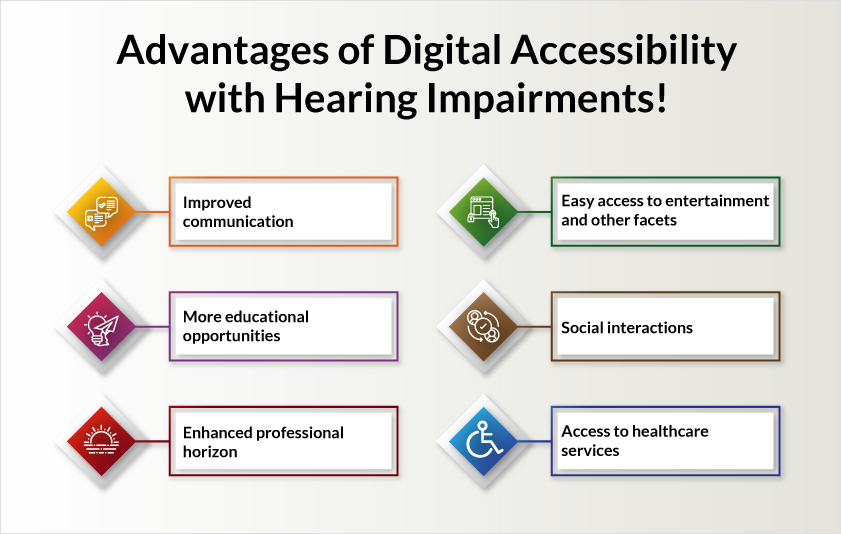
Improved communication
Through features like closed captions and transcripts, digital content becomes accessible to individuals relying on visual information. This inclusivity ensures that people with hearing impairments can engage with a wide range of content from online videos to virtual meetings, breaking down communication barriers that may have existed before.
YOU MAY ALSO LIKE: Video Accessibility
More educational opportunities
Increased digital accessibility opens educational avenues for hearing-disabled users. Subtitles, sign language interpretation, and other accommodations empower individuals to access educational content seamlessly. As a result, the digital landscape allows everyone to pursue their academic and professional goals irrespective of their abilities.
Enhanced professional horizon
When workplace communication tools, documents, and presentations are crafted with accessibility features, employees with hearing impairments can fully participate in meetings, and collaborate effectively. This does not only promote a diverse work environment but also harnesses the unique perspective and talents of individuals with hearing disabilities.
Easy access to entertainment and other facets
In the realm of entertainment, digital accessibility has revolutionized the way individuals with hearing impairments experience media. Streaming services and online platforms now offer a plethora of content with closed captions and subtitles. This not only broadens the entertainment options for such users, but also ensures that they can enjoy cultural and artistic expressions on an equal footing with their peers.
Social interactions
Increased digital accessibility contributes to the social well-being of individuals with hearing impairments. Social media platforms with accessibility features, enable seamless communication and connection. Whether through text-based interactions, visual content, or alternative formats, individuals with hearing impairments can actively engage in online communities, fostering a sense of belonging.
Access to healthcare services
Users with hearing impairments require access to healthcare information and services likewise other people. Online appointment scheduling, telehealth consultations with sign language interpreters, and accessible health information contribute to their better healthcare outcomes. So, digital accessibility becomes a cornerstone in building a healthcare system that caters to the diverse needs of all individuals.
YOU MAY ALSO LIKE: Digital Content Accessibility
Including accessibility for users suffering from hearing disabilities
Subtitles and captions
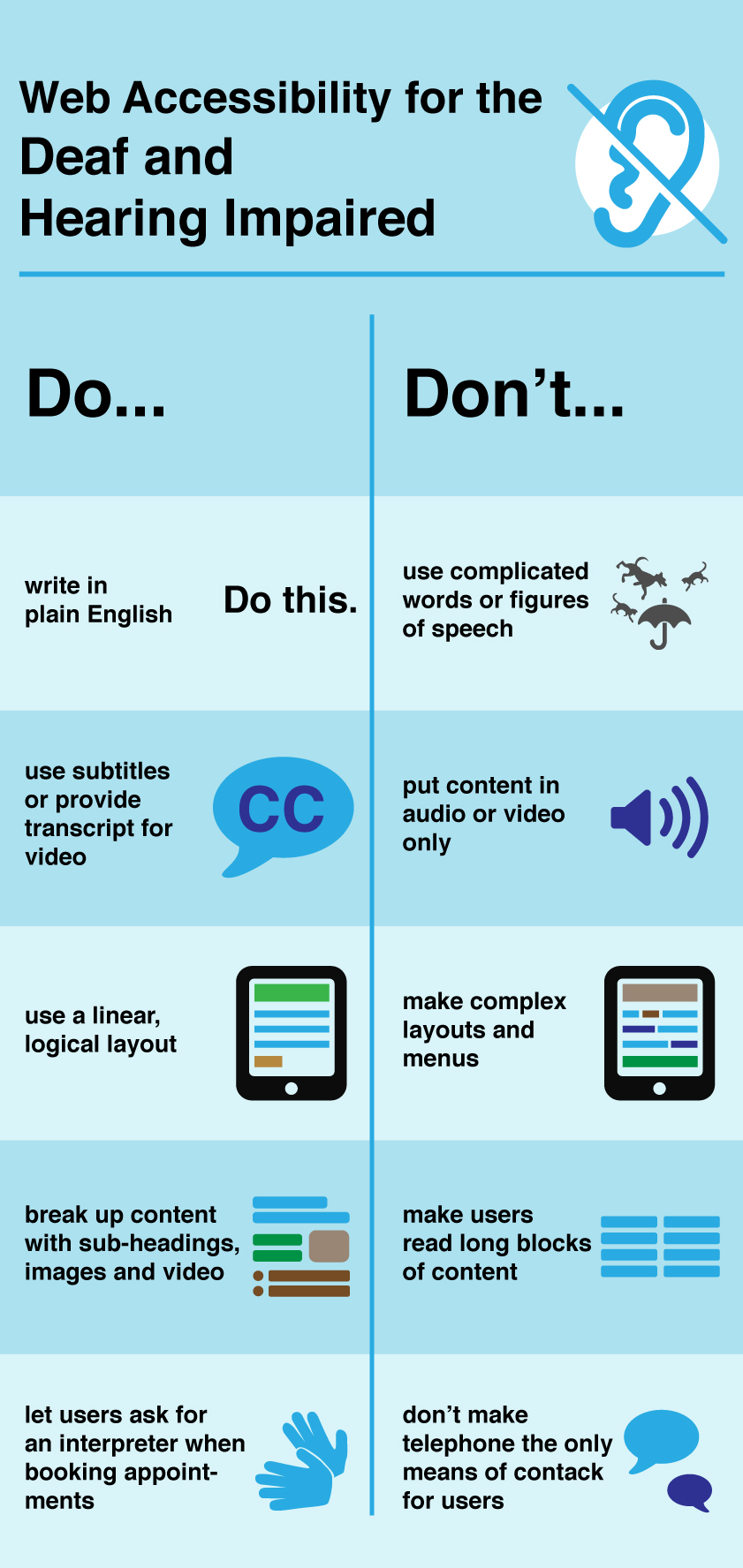
Videos need to have accurate captions and subtitles along with alt text. Also, ensure that the caption's font color is readable to everyone.
Visual notifications
Audio notifications will not work for users facing hearing disorders. Thus, there should be a mix of visual, audio, and haptic elements to boost the chances of notifications' maximum reach.
Chatbots
Organizations must include chat or email options along with phone numbers in the ‘Contact Us’ section. Therefore, if someone has difficulty in hearing, they will have other options to contact.
Transcripts
Some people might encounter trouble processing captions. Therefore, transcripts are also needed with video content to let people understand not only spoken content but also other sounds like laughter, background music, etc.
Use plain language
Since hard-to-read words may reduce readability for many, it is recommended not to use difficult words and longer sentences. Whichever language content is being written; it should be easy to read.
Easy navigation
To offer seamless navigation, place captions, transcripts, and other stuff at a predictable and consistent place for each page or video content for a website/application.
YOU MAY ALSO LIKE: Cost to make website accessibility compliant

Innovations to uplift user experience!
The push for digital accessibility for people with hearing impairments has spurred innovation. Tech organizations are creating innovative solutions such as real-time transcription services, speech-to-text applications, and communication devices that leverage cutting-edge technology to enhance accessibility.
These advancements not only benefit individuals with hearing impairments but also contribute to the overall progress of assistive technology. Moreover, the economic benefits of increasing digital accessibility are substantial. As organizations prioritize accessibility, they tap into a broader talent pool by creating inclusive digital environments.
Skynet Technologies helps make digital experiences more inclusive
The benefits of Digital Accessibility for Hearing Impairments extend far beyond compliance. Captions, transcripts, visual alerts, accessible multimedia, and clear communication can help people with hearing loss participate more independently in education, employment, online services, and everyday digital interactions. When accessibility is considered from the beginning, organizations can create experiences that work better for a broader range of users.
Skynet Technologies helps businesses and organizations address accessibility barriers across websites, web applications, documents, and other digital assets. Our services include accessibility audits, WCAG remediation, accessible design and development, document accessibility, training, monitoring, maintenance, and ongoing support. We also offer All in One Accessibility, an AI-powered accessibility widget with features designed to support diverse accessibility needs. Get a Free Accessibility Audit to identify barriers affecting your digital audience and explore practical ways to make your online presence more inclusive.