Global Accessibility Awareness Day (GAAD) is observed every year on the third Thursday of May to promote digital access and inclusion for people with disabilities. Founded in 2012 by accessibility advocate Joe Devon and accessibility professional Jennison Asuncion, GAAD encourages organizations, developers, designers, educators, and businesses to prioritize accessible digital experiences.
In 2026, GAAD will be observed on May 21, marking the 15th year of the global initiative.
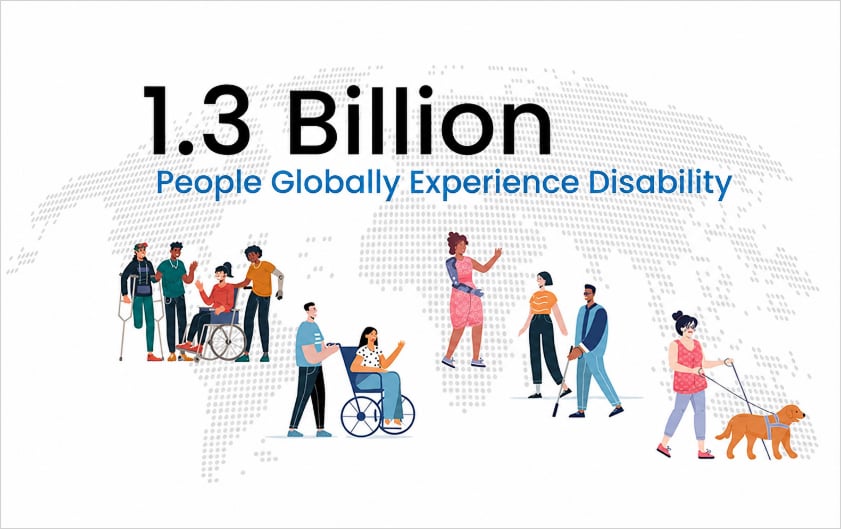
The most common types of disabilities

Visual
People with Visual disabilities from mild or moderate vision loss to substantial or complete vision loss; including color blindness, low vision, and complete blindness need alternative text, screen reader, and keyboard access.

Hearing
People who are deaf, hard of hearing, or hearing loss need subtitles or captions for video presentations and visual indicators in place of audio cues, multiple contact options like email, skype, live web chat, or online forms.
Motor
People who have motor impairments require alternative keywords, eye control or some other adaptive hardware to navigate on their devices.

Cognitive
People with different cognitive impairments need an uncluttered screen, consistent navigation, use of plain language, using bookmarks, and more.
By spreading the word, usability of digital products (websites, mobile applications, etc.) can be increased and then more people will be able to use them. Let’s know more about GAAD; keep reading!
YOU MAY ALSO LIKE: Web Accessibility Statistics
Why does global accessibility awareness day matter more in 2026?
Digital experiences have become essential to how people work, learn, shop, and access various government services, daily essential requirements (healthcare, banking, ecommerce), and connect socially. As organizations rapidly adopt AI, automation, and digital-first platforms, accessibility can’t be ignored or treated as a formality to avoid litigation.
In 2026, accessibility discussions are expanding beyond compliance to focus on inclusive user experiences, ethical technology, and digital equality. Businesses or organizations are increasingly recognizing that inaccessible websites, apps, PDFs, videos, and ecommerce spaces can exclude millions of users from participating fully in the digital world.
Special days like Global Accessibility Awareness Day encourage organizations to evaluate whether their digital assets allow every user to access and consume different products and services. The motive to observe such events is to reduce the numbers of inaccessible digital spaces, increase users’ participation in online activities, and improve business profits.
Some of the prominent accessibility failures websites still contain
Apparently, the vast majority (approx. 95.9%) of website homepages still contain detectable WCAG accessibility failures, highlighting the continued importance of accessibility awareness and remediation efforts.
| WCAG failure type | % of homepages affected (2026) |
| Low contrast text | 83.9% |
| Missing alternative text for images | 53.1% |
| Missing form input labels | 51% |
| Empty links | 46.3% |
| Empty buttons | 30.6% |
| Missing document language | 13.5% |
Source reference: WebAIM Million Report 2025/2026 findings.
Common digital accessibility barriers still affecting users
- Complex navigation structures that make it difficult for users to locate important information.
- PDFs and downloadable documents that are not compatible with screen readers.
- Videos, webinars, and live streams without captions or transcripts.
- Inaccessible online booking systems, checkout flows, and payment processes.
- Pop-ups and interactive elements that are difficult to operate using assistive technologies.
- Time-limited sessions or forms without adequate warning or extensions.
- Mobile apps and responsive websites with inconsistent accessibility support.
- Overuse of animations, flashing content, or cluttered layouts that increase cognitive load.
- Poorly structured tables and data presentations that are difficult to interpret.
- Lack of accessible customer support channels for users requiring assistance.
Simplifying accessibility improvements with All in One Accessibility
Organizations looking to improve website accessibility can also leverage accessibility enhancement solutions like All in One Accessibility. This accessibility widget enhances website usability for people with visual, cognitive, motor, and age-related impairments through features such as screen reader support, voice navigation, color adjustments, keyboard navigation assistance, reading enhancements, 190+ multi-language support, and many more.
Unlock 20% OFF with AI accessibility widget to enhance website's digital inclusive experience!
Use coupon code: at the checkout.
Upgrade website with powerful accessibility features.
*The code is valid for the first-time purchase / new customers and annual plans. Not applicable on renewal.
While accessibility widget does not replace manual accessibility audit or WCAG remediation, they can support organizations in creating more inclusive and user-friendly digital experiences as part of a broader accessibility strategy.
Emerging accessibility trends businesses should focus on
- AI-powered accessibility requires human oversight
AI tools are increasingly being used to identify accessibility issues, generate alt text, automate captions, and improve testing workflows. However, accessibility experts emphasize that AI alone cannot guarantee compliance or usability. Human testing, assistive technology testing, and real-user feedback remain critical.
- Accessibility is shifting from compliance to experience
Organizations are moving beyond one-time audit and focusing on accessibility-first design practices integrated into development workflows. Businesses now recognize accessibility as a quality standard that improves usability for all users.
- Cognitive accessibility is gaining more attention
Accessibility discussions are expanding beyond visual impairments to include cognitive accessibility, plain language, predictable navigation, reduced cognitive load, and user-friendly interfaces.
- Accessibility regulations are becoming stricter globally
Countries across the U.S., Europe, Canada, Australia, and other regions continue strengthening accessibility regulations and procurement requirements, increasing the need for WCAG-compliant digital environments.
How can organizations participate in GAAD?
Businesses / organizations can observe Global Accessibility Awareness Day by:
- Conducting accessibility audits for websites and mobile apps.
- Hosting accessibility awareness workshops and webinars.
- Training teams on WCAG guidelines and inclusive design.
- Testing digital products with assistive technologies.
- Real time usability testing by people with disabilities.
- Reviewing PDFs, videos, ecommerce flows, and digital documents for accessibility.
- Creating long-term accessibility roadmaps instead of one-time fixes.
Wrapping up
Global Accessibility Awareness is an opportunity for organizations to strengthen their commitment to inclusive digital experiences that everyone can access and use. Building accessibility into websites, mobile applications, documents, and digital platforms from the beginning helps improve usability, supports compliance with accessibility standards, and creates better experiences for people of all abilities. Making accessibility an ongoing priority enables organizations to serve a broader audience while reducing compliance risks.
As an associate member of the International Association of Accessibility Professionals (IAAP) and an official member of the W3C, Skynet Technologies helps organizations create accessible and compliant digital experiences through accessibility audits, remediation, consulting, accessible design and development, document accessibility, mobile accessibility, and continuous monitoring services. Request Your Free Accessibility Audit to identify accessibility gaps and take the next step toward a more inclusive digital experience.